
Complete Rooftop Solar Guide for Homeowners: Design, Sizing & Savings
Making the decision to transition your home to solar power is one of the most rewarding home improvement choices you will ever make. It adds substantial real estate value, eliminates predictable utility price inflation, and reduces your carbon footprint. However, understanding how the components work together and what questions to ask installers is crucial.
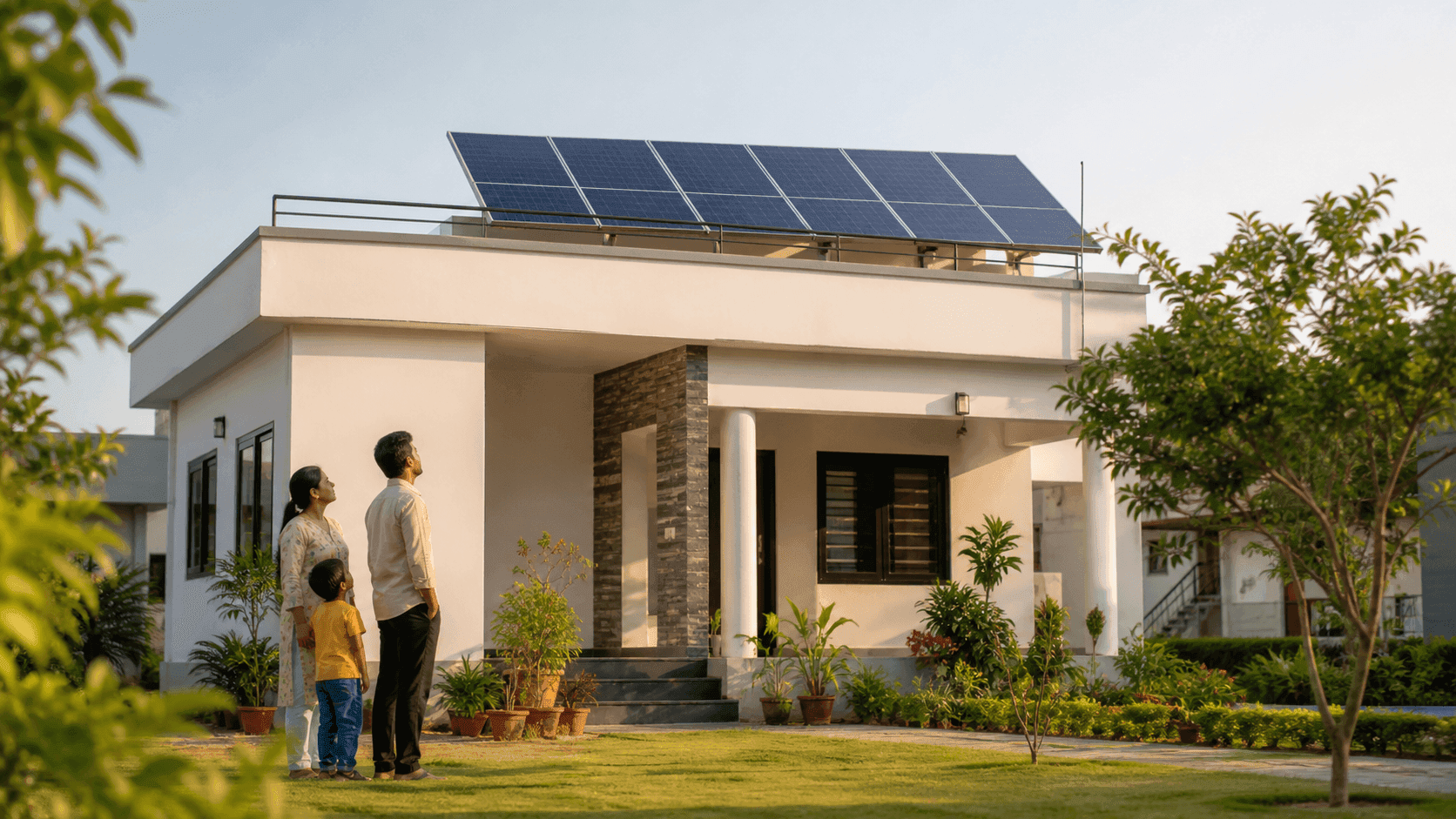
Key Engineering Takeaways
- Understanding the core difference between On-Grid, Off-Grid, and Hybrid residential solar.
- How to calculate the exact kilowatt capacity needed based on your monthly kWh consumption.
- Importance of south-facing orientation and shadow analysis across all four seasons.
- How high-efficiency Mono PERC and TOPCon modules minimize roof area requirements.
1. How a Rooftop Solar System Works
Solar photovoltaic (PV) modules absorb photons from sunlight and generate direct current (DC) electricity through the photovoltaic effect. Because household appliances operate on alternating current (AC), the DC power flows through heavy-duty solar cables into a high-efficiency smart inverter.
The inverter converts the DC electricity into stable 230V/415V AC electricity synchronized with your grid frequency. This power is routed directly into your home's main distribution panel, serving your appliances first. Any excess electricity is exported back to the utility grid through the net meter.
2. Assessing Your Rooftop Readiness
Before installation, three key factors must be evaluated: structural integrity, roof orientation, and shadow obstructions.
In the Northern Hemisphere (including India), solar panels must face South (azimuth angle ~180°) at a tilt of 25°-27° to capture maximum sunlight throughout the year. Water tanks, stairwells, parapet walls, and neighboring buildings must be modeled to prevent partial shading, which can trigger bypass diodes and reduce array generation.
3. Choosing Between On-Grid and Hybrid Systems
If your locality experiences reliable grid supply with rare power cuts, an On-Grid system is the most cost-effective solution with the fastest financial return.
If you experience frequent daytime or evening power outages, a Hybrid Solar System equipped with lithium-ion or solar tubular batteries is recommended. It ensures seamless battery backup for fans, lights, and computers during power cuts while continuing to offer net-metering credits.
Get Local Solar Engineering Support
Ready to calculate solar feasibility for your property in Bihar?
Speak with our Hajipur engineering team for honest advice, shadow analysis, and PM Surya Ghar subsidy application processing.