
Residential Solar Installation: How to Right-Size System Capacity for Your Home
Installing an undersized solar system leaves you with lingering electricity bills, while installing an oversized system beyond your annual consumption locks up capital unnecessarily. Right-sizing your residential solar capacity ensures maximum financial return, full subsidy utilization, and optimal roof space utilization.
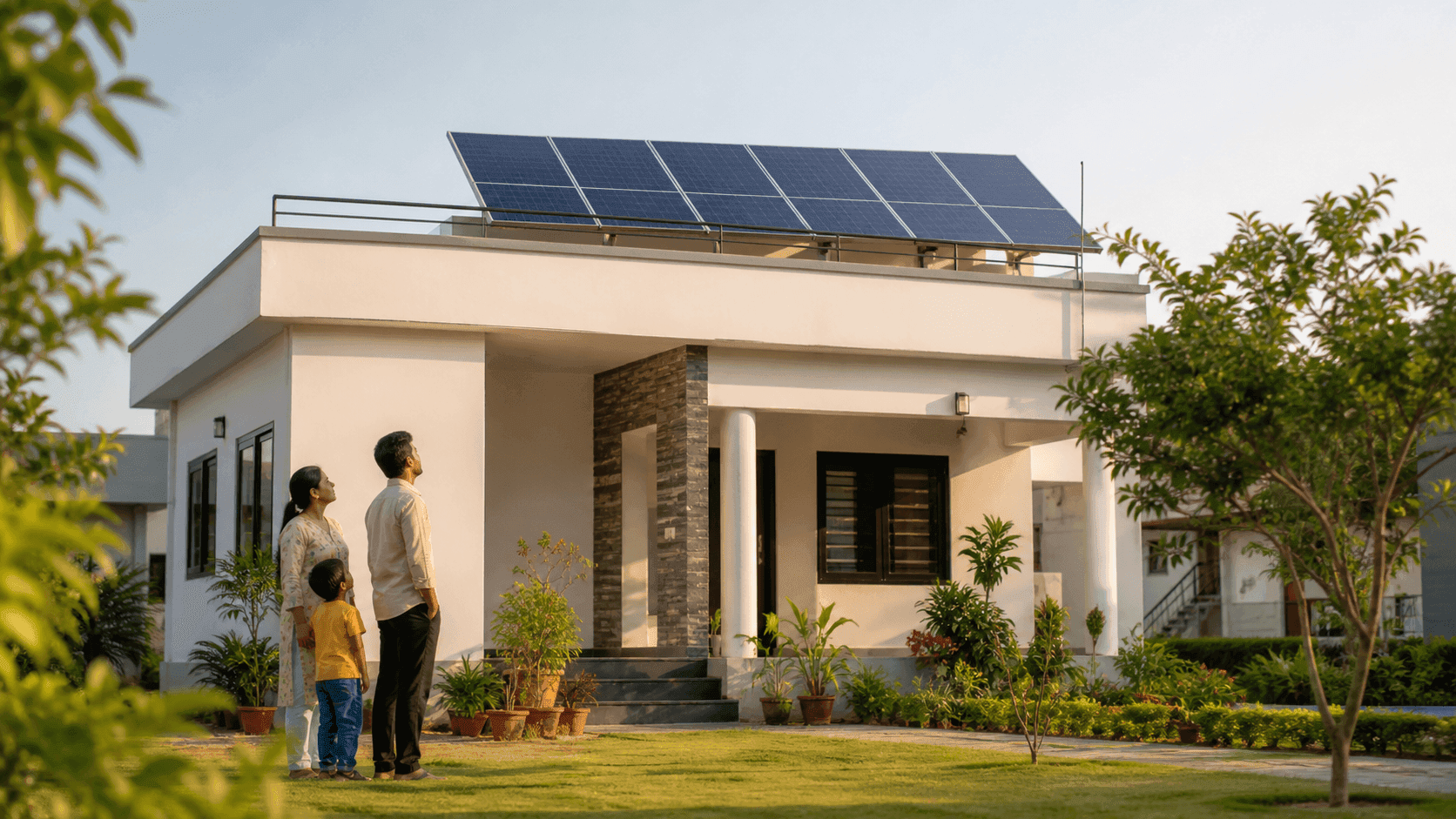
Key Engineering Takeaways
- How to calculate annual kilowatt-hour (kWh) demand from monthly utility bills.
- Daily generation benchmarks: 1 kW solar generates ~4 to 4.5 units per day in Bihar.
- How to budget for future load increases such as electric vehicles (EV) and additional air conditioning.
- Selecting the right inverter type and structural height for your home.
1. The Unit Consumption Calculation Formula
In Bihar, 1 kW of well-engineered, unshaded solar capacity produces an average of 4.0 to 4.5 kilowatt-hours (units) of electricity daily, accounting for seasonal variations throughout the year. This equates to approximately 1,400 to 1,500 units per kW annually.
To determine your required capacity, divide your average monthly unit consumption by 120 (the average monthly units generated by 1 kW in Bihar).
- Monthly bill of ~240 units (₹1,500 - ₹2,000) → Ideal Size: 2 kW System
- Monthly bill of ~360-400 units (₹2,800 - ₹3,500) → Ideal Size: 3 kW System
- Monthly bill of ~600-650 units (₹4,500 - ₹5,500) → Ideal Size: 5 kW System
- Monthly bill of ~1,200+ units (₹9,000+) → Ideal Size: 10 kW System
2. Accounting for Air Conditioning and Seasonal Swings
In North India, residential electricity consumption surges drastically between April and September due to continuous air conditioning operation. Fortunately, solar generation peaks during these exact summer months, providing maximum power output right when your cooling loads are highest.
Under net metering, any surplus solar energy generated during mild spring and winter months is banked with DISCOM as energy credits, offsetting higher summer consumption seamlessly.
3. Rooftop Area Requirements & Panel Efficiency
Modern high-efficiency Mono PERC and TOPCon panels (540Wp to 580Wp) require approximately 80 to 90 square feet of shadow-free rooftop area per kilowatt.
A 3 kW system requires roughly 240-270 sq. ft., while a 5 kW installation needs about 400-450 sq. ft. Elevated mounting frames allow you to install this capacity without losing usable terrace floor space.
Get Local Solar Engineering Support
Ready to calculate solar feasibility for your property in Bihar?
Speak with our Hajipur engineering team for honest advice, shadow analysis, and PM Surya Ghar subsidy application processing.